

Optical Communications and the VLEO Edge
2026-07-31
Artemis demonstrated the significant benefits of optical communications in space; VLEO promises major improvements for this valuable technology.
-Sachin Solanki
In April 2026, four astronauts streamed 4K video from the Moon, in this case, the Earth “setting” as Artemis II’s Orion spacecraft continued in its orbit. In a world where streamed content accounts for a larger and larger proportion of information consumption [1], such an accomplishment may have gone unnoticed. However as someone working on spacecraft communications, I was focused on the feat of engineering which enabled this, and curious to learn more.
The key was how the information was transmitted down to the Earth, not over radio waves like traditional spacecraft communications but rather over light.
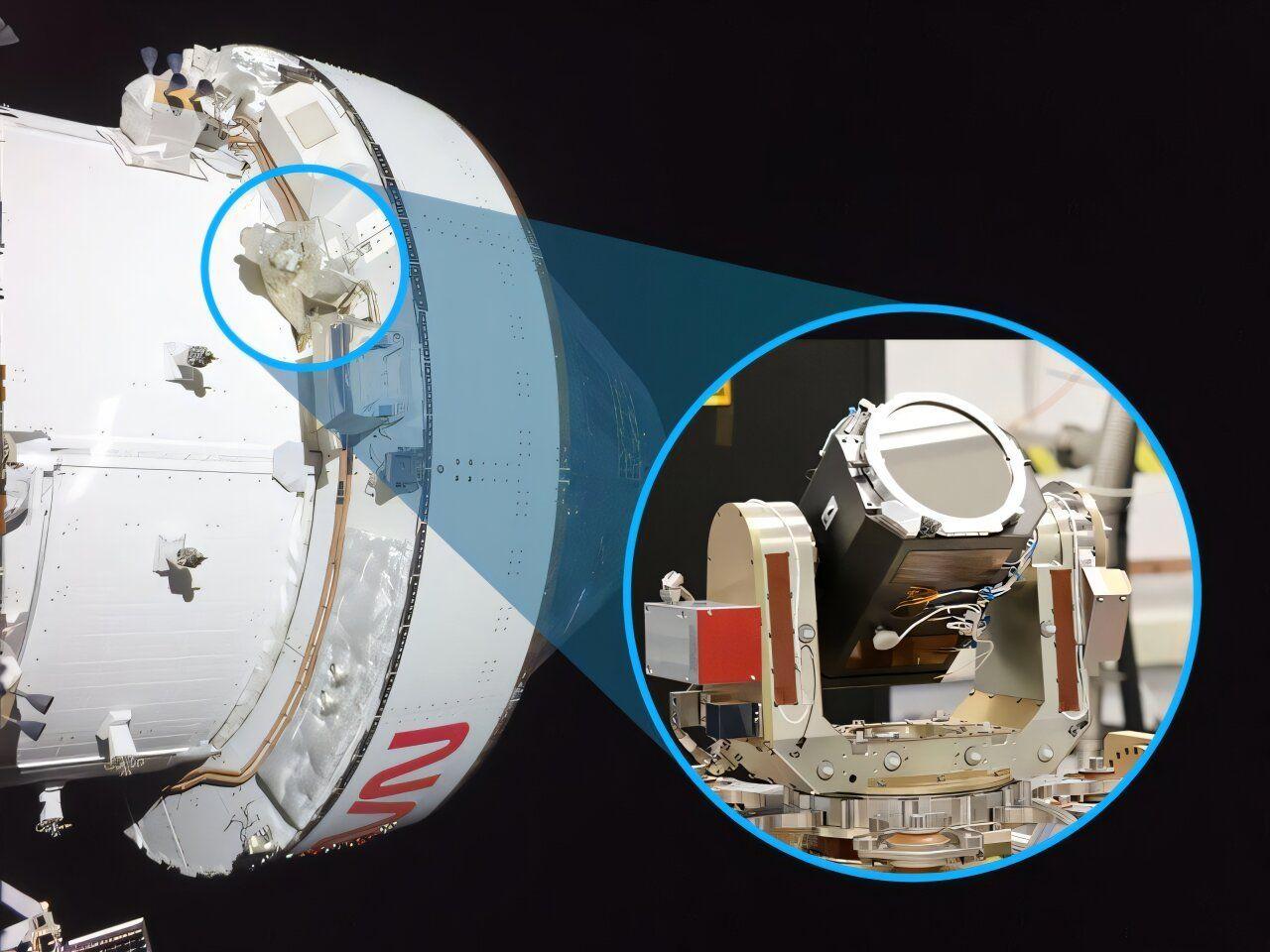

Optical communications terminal on the Artemis mission
What is Optical Communications
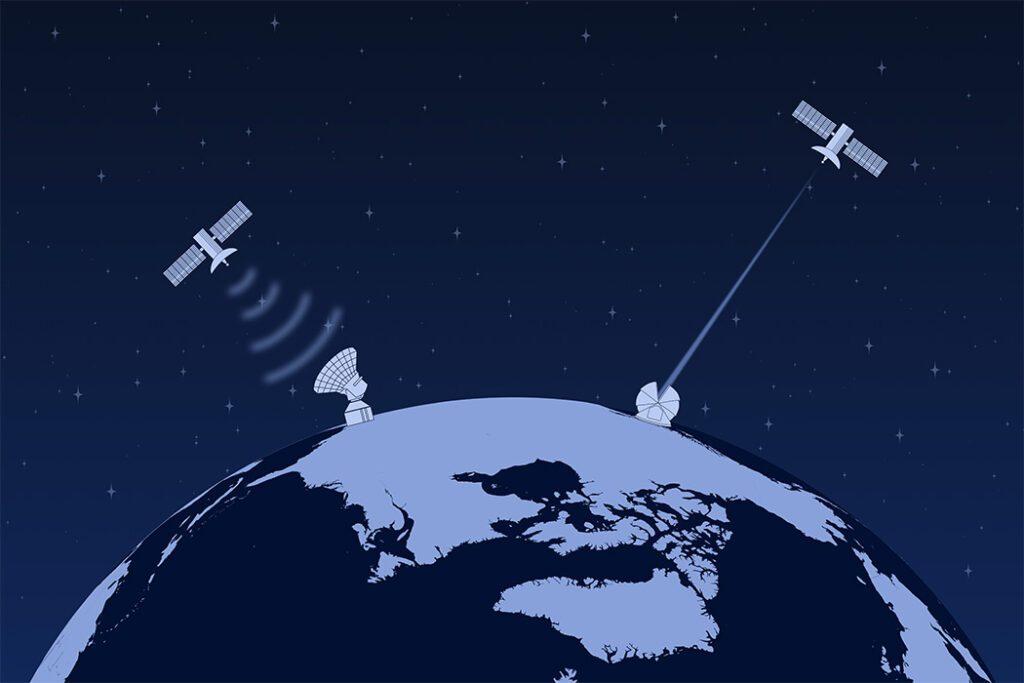
Optical communications, as the name suggests, involves using light to communicate between two points, a transmitter and a receiver. Traditionally, a spacecraft has communicated using radio waves, the same technology behind DAB radio, Wi-Fi and mobile data, encoding information on a modulated carrier wave. In the case of spacecraft communications, different bands of frequencies are reserved for operating the spacecraft, downloading imagery data and radar. Optical communications does the exact same job, moving data from point to point, but swaps the RF carrier wave for infrared light. A laser terminal produces an infrared beam in the direction of the receive terminal far away. This is the same technology already at work behind the scenes likely allowing you to read this article, fibre optic internet. The reason this swap matters is down to how precisely the signal can be focused. An antenna typically radiates its signal out over a wide cone, not too dissimilar to a light bulb, so that only a fraction of the energy ever reaches the intended receiver. A laser terminal, on the other hand, behaves more like a laser pointer; an extremely narrow, tightly focused beam that directs almost all of its energy exactly where it's pointed. This tight focus also means far less of the signal's strength is lost to spreading as it travels, which is what allows optical links to close reliably over very long distances without needing a large transmitter or dish. Separately, infrared light sits at a frequency roughly ten thousand times higher than the radio bands used for spacecraft communications, and that higher frequency comes with proportionally more usable bandwidth to encode data onto, which is the main reason optical links can achieve such dramatically higher data rates than radio. Together, this combination of tight focus and vastly greater bandwidth is why optical communications can outperform radio so significantly, in both range and speed.
Why It's Useful
The increase in capability observed between the Apollo programme in the 1960s and the Artemis programme of the 2020s tells the story of why optical communications is the way forward for high throughput links. The Apollo Command Service Module (CSM) had an S-band RF system capable of a maximum of 51.2 kilobits per second (kbps) for downlinking data from the Moon [2]. In comparison, a terrestrial landline for voice uses 64 kbps [3] i.e. Apollo's peak data rate from the Moon was, remarkably, slower than a single phone line carrying voice today. Artemis II's optical system, by contrast, delivered data from the Moon at up to 260 megabits per second [4], over 5,000 times the speed of Apollo, rivalling or outperforming a typical 5G connection you'd get on your mobile phone today [5].
NASA's TBIRD experiment, flying much closer to Earth in low Earth orbit rather than at lunar distance, went further still, demonstrating a 200 gigabit-per-second downlink and moving more than a terabyte of data to the ground in a single pass lasting under five minutes; a jump of another three orders of magnitude on top of Artemis II's already substantial leap over Apollo [6].
Europe has been building this capability quietly and operationally for years, in parallel with NASA's demonstration missions. The European Data Relay System (EDRS) has used German-built laser terminals in active service since 2016, mostly relaying Earth observation imagery through a satellite parked in a much higher orbit [7]. A newer European mission, Eagle-1, is testing whether lasers can also be used to securely distribute encryption keys between ground stations [8].
Beyond raw speed, optical communications brings a few other advantages worth noting. Laser terminals tend to be small and low-power: the terminal flown on Artemis II, called MAScOT, is built around a telescope roughly the size of a coffee mug [9]. There are also no issues with radio frequency and bandwidth allocation, shared, regulated, and increasingly crowded public resources requiring an internationally coordinated filing before a transmitter can even switch on in space. In comparison light isn't regulated at all with no risk for interference. Furthermore, because the beam is so narrow, it's inherently difficult to intercept or jam, which is a large part of why military space programmes have been the biggest funders of the technology's development [10].
Drawbacks and Comparison to RF
The same precision that makes optical communications so capable is also the source of most of its problems.
Weather
A radio signal can pass through clouds, a laser beam can’t. Unlike RF stations which can beef up ground transmitters to beat cloud and rain cover, this isn't something you can compensate for with a stronger laser. Individual ground sites, even good ones, are typically only clear enough to use somewhere between 60 and 80 percent of the time. In order to set up a genuinely reliable service, one must build several ground stations, spread far enough apart (over roughly 1,000 km) that they aren't likely to be cloudy at the same time, and switching between whichever one currently has clear sky [11].
Precise Pointing
That pencil-thin beam which gives laser communications its advantages also makes it unforgiving to point. A satellite and a ground station both need to track each other with an accuracy measured in millionths of a degree, while the satellite is moving at several kilometres per second. Achieving that reliably places serious demands on a satellite's pointing and stability systems, and even locking onto the target in the first place eats into the already-short window a satellite has as it passes overhead.
Not reliable for operations
Because laser links can be rendered unusable by something as ordinary as a passing cloud, no mission should rely on them alone. They carry high-value data, like imagery or video, while a conventional radio link stays on hand as the reliable fallback for essential commands and housekeeping. Artemis II flew its laser system alongside NASA's conventional radio network, and it was the radio link, not the laser, that remained the mission's dependable backbone throughout. Optical communications, at least for now, features alongside RF rather than replacing it.
Why VLEO Stands to Benefit the Most
Very low Earth orbit, flying at roughly 250 km rather than the more typical 500 to 600 km, is where this technology's case gets genuinely compelling [13].
Flying lower means a much shorter distance for the light to travel, which makes the whole link noticeably easier to close. That saved margin can go straight into a smaller, cheaper, lighter terminal.
At the same time, flying lower is usually done specifically to get better resolution imagery or data [14]. That data-rich advantage creates its own problem: more data is generated, in a shorter window of contact with the ground, because a satellite that low crosses the sky faster and passes overhead more briefly. Laser communications is a great way to get all of that data down without a very large, power-hungry radio system.
References
[1] YouGov, "UK media consumption trends in 2026: TV, streaming and social media usage": https://yougov.com/en-gb/articles/54915-uk-media-consumption-trends-in-2026-tv-streaming-and-social-media-usage
[2] Apollo Unified S-Band Communications System, high-rate telemetry mode: https://ed-thelen.org/pics4/apollo-s-band.html
[3] ITU-T G.711, standard 64 kbps pulse-code modulation for digital telephony
[4] NASA, "Exploration and Space Communications: O2O" — 260 Mbps downlink rate: https://www.nasa.gov/goddard/esc/o2o/
[5] Ookla/Opensignal 5G speed reporting, 2026 — typical mid-band 5G download speeds of 150–300 Mbps
[6] NASA NTRS, TBIRD 200 Gbps downlink demonstration (Schieler et al.): https://ntrs.nasa.gov/citations/20230000434
[7] Cailabs, "Exceeding Throughput Limits with Laser Communications" — EDRS operational since 2016: https://www.cailabs.com/blog/aerospace-and-defense/exceeding-throughput-limits-with-laser-communications/
[8] Quasa, "EAGLE-1 Optical Ground Station Lease Signed by SES and Airbus" — Netherlands lease finalised July 2026: https://quasa.io/media/ses-and-airbus-advance-eagle-1-with-optical-ground-station-lease-in-netherlands
[9] MIT Lincoln Laboratory, "Lincoln Laboratory laser communications terminal launches on historic Artemis II Moon mission" — MAScOT terminal description: https://news.mit.edu/2026/lincoln-laboratory-laser-communications-terminal-launches-artemis-ii-0402
[10] Space Development Agency, "Military agency praised for leading the way on laser communications" — defence funding driving terminal development: https://www.sda.mil/military-agency-praised-for-leading-the-way-on-laser-communications/
[11] DLR, "Optical Satellite Downlinks to Optical Ground Stations and HAPs" (Fuchs et al.) — cloud-free line-of-sight availability and site-spacing requirements: https://elib.dlr.de/55548/1/OLEO-DL_to_OGS_and_HAPs-IST07.pdf
[12] SatNews, "The Downlink Deficit: The Pentagon's Optical Mesh Network and the Terrestrial Bottleneck" — 200–500 ground stations needed by 2030: https://satnews.com/2026/04/03/the-downlink-deficit-the-pentagons-optical-mesh-network-and-the-terrestrial-bottleneck/
[13] ESA CSC, "VLEO for Telecommunications" — VLEO defined as below ~300 km altitude: https://resilience.esa.int/archives/projects/vleo-telecommunications
[14] ScienceDirect, "The benefits of very low earth orbit for earth observation missions" — resolution and data-volume advantages of flying lower: https://www.sciencedirect.com/science/article/abs/pii/S0376042120300312